Medical documentation is essential to healthcare, but it eats up a lot of time. Many healthcare organizations now turn to scribe tools as a practical way to manage physician records. For years, that note-taking happened by hand, with medical scribes sitting in on consultations and writing everything down themselves.
As technology has moved forward, AI-powered scribe tools now take on much of that work, automating the process, logging details accurately, and connecting smoothly with EHR systems.
What Are Medical Scribe Tools?
Medical scribe tools are basically there to take the mess of a patient visit and turn it into something organized you can actually find later. Someone talks, the tool listens, and what comes out the other end is a proper medical record instead of scattered notes. Sometimes that “someone listening” part is a human scribe sitting in the room. Other times it’s AI software doing the transcription on its own.
Traditional vs. AI-Powered Scribe Tools
Trained medical scribes have long supported doctors by documenting patient conversations for them. But that approach comes with real costs, both in salary and in the manual errors that creep in over time. AI-powered scribe tools take a different route, using healthcare transcription AI to turn medical sessions into structured notes, then feeding them straight into EHR systems for documentation that’s both faster and more accurate.
How Do They Work?
With human scribes, the process is simple: they listen in on the conversation between doctor and patient, then type it up by hand before it goes into the EHR. AI-powered scribe tools work differently, using real-time voice recognition and NLP to transcribe the conversation automatically and format it for the record.
How Effective Are Scribe Tools?
Fast-paced healthcare settings depend on documentation that’s both quick and accurate to keep patient care at a high standard. Balancing real conversation with patients against the need to file complete EHR entries is a constant tension for medical staff.
Efficiency & Accuracy
AI medical documentation cuts down on transcription errors because it can read medical jargon and clinical context correctly. The result is cleaner documentation, fewer misinterpretations, and notes that hold up to regulatory standards.
AI transcription cuts documentation errors by around 40% compared to human transcription. For a closer look at how this works, check out our full guide to medical transcription with AI.
Physician Productivity
Documentation is a major driver of burnout in healthcare, and virtual or AI-powered scribe tools can help reduce charting time and stress for clinicians. However, the level of time savings varies by workflow, specialty, and implementation, so broad percentage claims should be used carefully.
Cost-Effectiveness
Human scribes can cost medical facilities around $55,000 a year a year in direct and employment-related expenses, while AI-powered scribe tools are often less expensive on a per-provider basis. For many healthcare organizations, AI scribes may offer a more practical way to improve documentation workflow, though costs and outcomes vary by setting.
Compliance & Security
Patient data isn’t something healthcare organizations get to take chances with. Scribe tools that meet HIPAA standards lock that data down with encryption, so it stays protected. They also track who accesses what, and access itself depends on a person’s role, which keeps medical information away from anyone who shouldn’t be seeing it.
AI-Powered Scribes – The Future of Medical Documentation
Healthcare keeps changing, and technology is a big part of why, both in how efficiently clinics run and in how well patients are cared for. One of the clearest shifts in medical documentation came with the arrival of AI-powered scribe tools.
Through the combination of artificial intelligence together with NLP and machine learning tools, these systems conduct automatic transcription and formatting and EHR integration of clinical notes.
Key Features of AI-Powered Scribe Tools
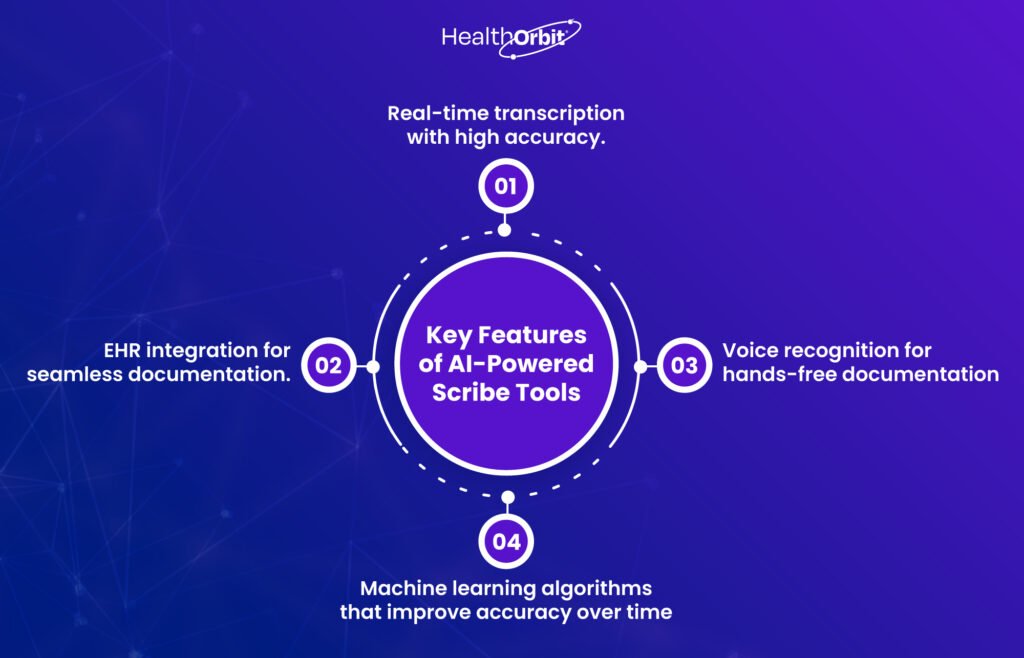
- Real-time transcription with high accuracy.
- EHR integration for seamless documentation.
- Voice recognition for hands-free documentation.
- Machine learning algorithms that improve accuracy over time
How HealthOrbit AI Provides an Advanced AI-Powered Scribe Solution?
HealthOrbit AI brings together a full set of scribe tools built to streamline medical documentation. By pairing advanced speech recognition with NLP and secure cloud storage, it gives physicians one complete solution that keeps their workflow smooth while staying within medical regulations.
Conclusion
Medical documentation is changing fast, and a big part of that is AI-powered scribe tools making things more accurate, quicker, and less of a drag on physicians’ time. Less paperwork means facilities can put their money toward things that actually matter, and staff get to spend more of their day with patients instead of typing notes.
Where this goes from here will probably come down to platforms like HealthOrbit AI that keep pushing the tech forward. Try our demo today and see what HealthOrbit AI can do for your practice. Signup Now
FAQs
What are scribe tools in healthcare?
Healthcare professionals use programming tools that turn recorded discussions into structured medical documentation records when treating patients.
How do AI-powered scribe tools work?
AI-powered scribe tools run real-time operations through voice recognition methods and natural language processing systems combined with machine learning to transform speech into structured EHR documentation.
Are AI-powered scribe tools secure?
Scene patient information remains secure because AI-powered scribe tools meet HIPAA standards by having encryption security along with tracking logs and separate permissions for different user roles.
How do AI scribes improve physician productivity?
Medicine practitioners who use AI scribe systems can finish their documentation tasks 70% faster which results in increased attention to patient care while reducing their occupational exhaustion.
Are AI-powered scribes better than human scribes?
The accuracy along with speed and endless availability without costs and fatigue makes AI-powered assistants better than human scribes who offer personal service. These systems create a smooth connection with EHR systems.