If you’ve ever sat down after a packed day in oncology, staring at a mountain of half-finished notes, you know the burden documentation places on cancer care. Oncology isn’t just about prescribing treatment—it’s layers of decision-making, complex cases, fast-changing conditions, and deeply personal patient conversations. And all of that needs to be recorded with clarity and accuracy.
That’s why smarter oncology documentation isn’t just a nice-to-have; it’s becoming essential. From SOAP notes to treatment plans and patient updates, oncologists need documentation tools that support their pace, precision, and patients. That’s where ambient AI scribe tools step in.
Let’s walk through what’s changing with modern ambient tools and how HealthOrbit AI is helping oncologists focus less on the keyboard and more on care.
Why Oncology Documentation Matters More Than Ever?
In short, accurate oncology documentation isn’t optional—it’s foundational. Whether you’re recording chemo orders, assessing new metastases, or updating a patient’s status post-immunotherapy, every detail matters. Compared to many specialties, oncology documentation carries a higher weight. Here’s why:
- It guides complex care decisions, from diagnostics to multi-step therapies.
- It ensures continuity between oncologists, radiologists, surgeons, and palliative care teams.
- It protects against compliance issues and billing denials in one of the most heavily scrutinized specialties.
Ambient Technology Is Changing the Game for Oncology
Traditional documentation methods—typing, dictation, templates—can’t keep up with the volume and nuance of cancer care notes. Even with EHRs, many oncologists still finish their notes long after their last patient leaves.
That’s where ambient technology steps in. Instead of forcing clinicians to switch between caring and clicking, it works quietly in the background, listening to natural conversations, identifying key clinical elements, and producing structured notes.
A pilot study presented at the ASCO Quality Care Symposium examined the use of ambient AI scribing in oncology practices. Physicians reported improved documentation quality and time savings, indicating that ambient AI scribes can alleviate administrative burdens in complex care environments.
The result? Smarter, more complete records with fewer interruptions.
And that’s exactly what HealthOrbit AI is built for.
Smarter SOAP Notes for Oncology Care
Most oncology notes aren’t just SOAP notes—they’re more like SOAP novels. Patients bring in complex histories, shifting symptoms, emotional needs, and new side effects every visit. And all of that must be translated into meaningful, compliant, billable documentation.
Ambient scribe technology is getting better at identifying and organizing these elements in real time. The Subjective piece includes fatigue, nausea, or pain scores. Objective captures labs, imaging, and physical findings. The Assessment reflects changes in staging or response. And the Plan outlines next steps—from radiation to genetic testing.
HealthOrbit AI understands this flow. It doesn’t just transcribe—it creates clean, structured oncology documentation that’s accurate and usable, saving you from double work later.
EHR Transcription Without the Toggle Fatigue
We’ve all been there—switching between tabs, hunting down the right EHR section, copying notes into fields that never feel intuitive.
Future-ready EHR transcription tools eliminate that step. HealthOrbit AI, for example, is designed for seamless EHR integration, meaning the note flows right into the correct section of the patient chart—no extra toggling, copying, or clicking.
That might sound small, but over a week or a month, it adds up to hours saved and fewer headaches. And when you’re already juggling patient load, treatment planning, tumor boards, and care coordination—that’s huge.
Patient Care Support That Starts With Listening
Oncology is emotionally intense. These aren’t 10-minute wellness checkups. These are life-altering conversations where patients are vulnerable, confused, and scared. That’s why real-time documentation matters—it allows oncologists to be fully present.
Ambient AI scribe tools give you back that focus. You listen, explain, and support—while your notes are built in the background.
This kind of patient care support is where documentation meets empathy. Because when you’re not typing or remembering details hours later, you’re truly present in the room.
Built-in Compliance: Notes That Meet the Mark
Compliance isn’t just paperwork—it’s protection. Oncology billing is audited more often than many other specialties, and small errors can lead to denials or worse.
With smarter documentation tools, compliance checks are built in. HealthOrbit helps ensure that required elements are included, structured correctly, and aligned with billing standards.
That includes:
- Proper staging and diagnosis coding
- Chemo infusion orders and supportive care
- Progress tracking in SOAP notes
- Alignment with HIPAA compliance standards
AI Clinical Notes Without the Generic Output
If you’ve ever read a templated note and thought, “This doesn’t sound like me,” you’re not alone. Oncology is too nuanced for cookie-cutter documentation.
That’s why HealthOrbit focuses on AI clinical notes that reflect your voice, your findings, and your decisions. It doesn’t just pull keywords—it captures the story. And that’s what makes documentation truly useful, especially across a multidisciplinary care team.
How HealthOrbit AI Supports Modern Oncology Workflows?
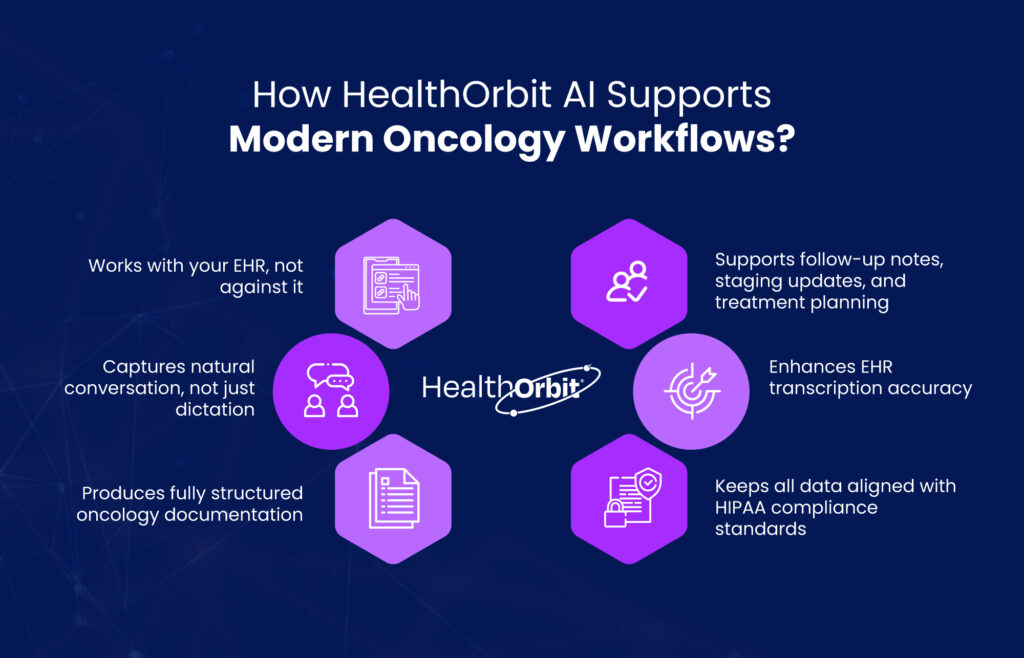
Let’s be clear: there’s no “one-size-fits-all” in cancer care. And that’s why tools like HealthOrbit are built with flexibility. Here’s how it fits into your workflow:
- Works with your EHR, not against it
- Captures natural conversation, not just dictation
- Produces fully structured oncology documentation
- Supports follow-up notes, staging updates, and treatment planning
- Enhances EHR transcription accuracy
- Keeps all data aligned with HIPAA compliance standards
The result? Cleaner notes, fewer errors, and time back in your day.
The Bigger Picture: Less Burnout, Better Outcomes
Burnout is real, and oncology is at the front lines. Between long hours, high stakes, and emotional toll, documentation fatigue adds to the weight. Smarter tools reduce that burden.
When your notes write themselves, your headspace opens up. When your system works in sync, your focus returns to patients. And when your documentation reflects your care clearly, outcomes improve for everyone involved. Here’s how that shift pays off:
- More time for direct patient care. When your time isn’t swallowed by charting, you have more freedom to connect with patients and families.
- Better work-life balance. Logging off at a reasonable hour becomes a reality, not a fantasy.
- Improved focus during clinical hours. With documentation handled, you can be more mentally present during visits.
- Reduced risk of errors and missed details. Real-time, structured notes lessen the likelihood of critical information being overlooked or misfiled.
- Long-term retention and satisfaction. Providers who feel supported by their tools, not burdened by them, are more likely to stay in the profession.
HealthOrbit AI isn’t just solving a paperwork problem—it’s helping solve a people problem. By reducing friction in SOAP notes, easing the burden of EHR transcription, and supporting high-quality AI clinical notes, it gives oncologists something hard to quantify: peace of mind.
Conclusion
The future of oncology documentation isn’t about shortcuts—it’s about smarter support. With ambient tools like HealthOrbit AI, oncologists can keep pace with complex care without drowning in paperwork.
You don’t need to change how you treat cancer. You just need a tool that supports how you work. HealthOrbit does exactly that—quietly, accurately, and seamlessly.
From SOAP notes to EHR transcription, from AI clinical notes to patient care support, this is documentation built for the realities of oncology. Less typing. More connecting. Better care.
Try our free demo today – Experience the Amazing Ambient Scribe Features.
FAQs
How is ambient technology different from traditional dictation?
Ambient tools work in the background of live patient conversations, rather than requiring separate voice recordings. That means real-time note creation without interrupting your workflow.
Are ambient scribes secure for oncology documentation?
Yes. Leading tools like HealthOrbit AI are designed for full HIPAA compliance, with secure encryption, access controls, and audit trails.
Can ambient AI scribe recognize oncology-specific terminology?
Absolutely. HealthOrbit AI is trained to understand clinical context, including oncology-specific terms, treatment stages, and SOAP note structures.
Does this replace my current EHR?
No, it enhances it. With built-in EHR integration, HealthOrbit works inside your current workflow without requiring system overhauls.
Will my notes still sound like me?
Yes. The system captures your language and clinical reasoning, so your notes reflect your actual encounters, not generic templates.