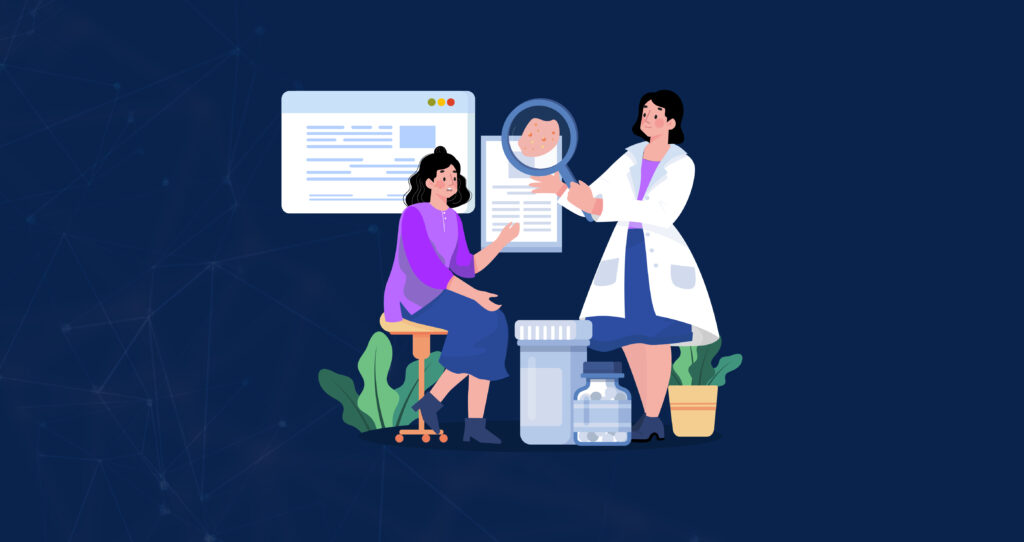
The writing of dermatology clinical notes is a process of careful consideration between clinical correctness and the necessity of having fast and easily readable documentation. The documentation of a rash, lesion, biopsy result, and prescription are all peculiarities that basically belong to the experience of each dermatology patient. If carried out without a system, some of the really good content might be lost in the main points.
In this blog post, you will find out about dermatology SOAP note templates, actual dermatology clinical notes examples, and best practices for clear, compliant, and efficient documentation. If you are a dermatologist, nurse practitioner, or resident, this post will additionally support you in your efforts to document effectively and communicate patient information.
What is a Dermatology SOAP Note Template?
A dermatology SOAP note template is a systematic structure for recording each patient visit. The entire process is categorized into the four main areas of Subjective, Objective, Assessment, and Plan. Thus, your case notes will be short yet effective and consistent for each one. The following describes what each of the sections looks like in the dermatology practice:
- Subjective: View of a patient – symptoms, duration, precipitants, and prior treatment.
- Objective: Clinical (lesion color, size, location, and diagnostic findings, e.g., biopsy, dermoscopy).
- Assessment: What is your clinical impression? Is it eczema, psoriasis, or actinic keratosis
- Plan: Prescription, medications, and follow-up.
What are the Benefits of Dermatology E/M Coding Documentation?
In control over the documentation and charting process, a 2025 Journal of Drugs in Dermatology research discovering that roughly one out of every two dermatologists in the U.S. (49 %) experienced burnout in the year 2023 reported mainly due to this burden; the researchers took a look at 18 different AI-assisted documentation products and proposed that these applications might alleviate the burden of note-taking and subsequently enhance the efficiency of medical professionals. Here’s why it matters:
1. Supports Accurate Billing
Proper dermatology E/M coding documentation connects your clinical notes directly to billing codes. The work is based on the true complexity of the visit, and, therefore, fairly reimbursable.
2. Improves Compliance
As the healthcare environment is highly regulated, it is important to remain in accordance with HIPAA-compliant findings and payer regulations. Audits are stress-free when properly documented E/M notes are available.
3. Reduces Rework
Unfinished or indistinctive notes tend to result in rework or rejection. It provides a template of a clear dermatology procedure note that will ensure all the visits are shown in the proper order.
4. Enhances Communication
Effective documentation enhances teamwork between dermatology teams, and patients are regularly tracked, including during diagnosis and subsequent treatment.
Dermatology SOAP Note Example – For Better Understanding
Here’s a simplified dermatology SOAP note example to show how information flows logically:
Patient: Sarah M., 34-year-old female
Date: 10/14/2025
Provider: Dr. L. Khan, MD, Dermatology
Subjective:
Denies any swelling in the right forearm, but complains of a red, itchy rash on the right forearm within 10 days. No skincare products have been used in the recent past. Denies systemic or fever.
Objective:
On the right forearm, there is an erythematous, scaly patch that is 3×4 cm. No vesicles or discharge. Determined negative in secondary infection.
Assessment:
Likely contact dermatitis (L23.9).
Plan:
Order topical corticosteroid (Triamcinolone 0.1 per cent). Recommend the prevention of the possible irritants and plan a follow-up after 2 weeks.
This dermatology clinical notes example is brief but thorough. It will record the critical clinical findings, aid with the accuracy of coding, as well as clarity in follow-ups, all significant in the ease of EHR documentation.
What Tips Should You Follow to Write Dermatology Clinical Notes?
Even with the best templates, the quality of your dermatology clinical notes depends on your writing habits. The following are some of the few and useful tips that will help make your notes work wonders in complying.
Be Concise
Use no redundant terminologies or plagiarism. Pay attention to pertinent information, symptoms, results, and how you feel about the patient. A brief note will conserve review time for you as well as other providers. In high-traffic clinics, accuracy in brief is silver.
Use Clear Language
Any member of the care team can be expected to understand what you have written. Do not use abbreviations that may mislead others. Effective communication will make coordination more efficient and minimize the number of mistakes.
Stay Organized
The regularity of design makes it more understandable. Using a dermatology SOAP note template or dermatology procedure note template keeps every note structured and complete. Enter all the standard fields, including date, provider, lesion description, diagnosis, plan, etc. Make sure that you complete all the fields.
Update Regularly
Dermatology is the study of chronic diseases, which require constant monitoring. Regularly update your dermatology clinical notes after each visit or patient call. Right timelines help in keeping track of progress, designing patterns, and altering treatment early on.
Why Are Dermatology Procedure Note Templates Important?
Special emphasis is needed in the dermatology procedural documentation, which may be cryotherapy, biopsy, or excision. A dermatology procedure note template has all the essential details, such as consent, site prep, anesthesia, procedure description, and post-care instructions. Benefits Include:
- Uniformity among providers.
- Correct billing and liability record.
- Streamlined audits and compliance audits.
- Simple interoperability with EHRs.
Why Should You Choose HealthOrbit AI?
We know that speed, accuracy, and compliance are essential to dermatologists without, at HealthOrbit AI, being overwhelmed by paperwork. Our AI-based clinical notes will assist you in documenting, organizing, and reviewing clinical information with ease and remain compliant with HIPAA. You can with our dermatology-oriented tools:
- Take notes on SOAP in real time.
- Auto-organize patient data into fields.
- Integrate with your EHR system.
- Conserve time per week on paperwork.
Conclusion
Good documentation has to do with good care. The clinical notes of the dermatology department are not only clear and accurate but also help in smooth billing, coding, and audits, apart from better diagnosis and treatment.
If you go with structured templates like the dermatology SOAP note template and dermatology procedure note template, you can make your workflow easier while keeping professional accuracy. It is time to refurbish the workflow when you want your dermatology records to be quicker, easier, and more compliant.
Try HealthOrbit AI today and experience how smarter documentation keeps your clinic running seamlessly.
FAQs
1. What should be included in dermatology clinical notes?
A comprehensive note must contain details about the patient, findings on skin, assessment, and treatment plan, as well as giving oof follow-upup instructions.
2. How do dermatology SOAP notes improve accuracy?
They guarantee a uniform format with all patient visits, eliminating the missing data and making coding easier.
3. What is the difference between a SOAP note and a procedure note?
SOAP notes record general visits and diagnoses, whereas procedure notes will be devoted to particular treatment or surgical interventions.
4. Are HealthOrbit AI tools HIPAA compliant?
Yes, HealthOrbit AI provides an opportunity to store and work with all the data safely according to the standards of HIPAA compliance.
5. Can templates be customized for different dermatology cases?
Absolutely. Use templates to suit your clinical requirements, e.g., acne, eczematous, psoriasis, or post-surgical follow-ups.