
Denied claims cost more than money. They eat into staff time, stall cash flow, and wear down patient trust once billing turns messy. If your team keeps catching errors after submission instead of before, you already know how much that lag costs. Claim scrubber software fixes this by checking claims against payer rules and coding standards before they leave your system.
The tools available in 2026 look different from just a couple of years back. Some use AI to catch patterns a person might miss. Others focus on tighter EHR integration.
Below are ten tools that make up the top claims scrubber software picks right now, along with what makes each one different and what’s worth weighing before you settle on one.
What Is Claim Scrubber Software and Why It Matters
A claim scrubber checks a claim before it ever reaches a payer. It looks at the codes, patient details, formatting, all of it, and flags whatever looks off, whether you’re running a small clinic or a large hospital system.
Here’s why it matters. One wrong modifier or outdated code doesn’t seem like much on its own. But it can leave a claim unpaid for weeks, and few practices can afford cash tied up that long. A claim scrubber in a healthcare setting stops being optional once claim volume outpaces what a couple of billers can manually check.
What a good scrubber actually catches:
- Codes that are wrong, outdated, or don’t match the diagnosis
- Patient information that’s missing or doesn’t line up
- Formatting one payer requires that another doesn’t
- Claims submitted twice by mistake
- Bundling errors that trigger an automatic denial
How We Evaluated These Tools
Not every scrubber deserves a spot on a top 10 list just because it’s popular. We looked at a handful of things that actually affect whether a piece of claim validation software earns its cost.
- How well it integrates with common EHR and billing systems
- Whether payer rules get updated regularly, since rules change often, and a stale rule set defeats the purpose
- Accuracy in catching real errors, not just flagging everything to look thorough
- Whether billing staff who aren’t trained coders can actually use it without a steep learning curve
- Reporting that actually helps you find patterns in why claims get rejected
A tool can look impressive in a demo and still fall short here. That’s what actually separates a tool worth the money from one that just adds another login to remember.
The Top 10 Claims Scrubbing Tools Compared
Everyone selling claims scrubber software says theirs is the best. Most aren’t, once you look past the homepage. What actually separates the good ones: rules that get updated regularly, integration that fits the EHR you’re already using, and reports that explain why a claim got rejected, not just that it did.
Here are 10 that held up when we looked closely in 2026.
| Tool | Market | Category | Best For | Pricing |
| HealthOrbit Claim Scrubber | UAE, UK, South Africa | AI claim scrubber | Practices seeking AI-powered claim validation | Quote-based |
| eClaimLink | UAE (Dubai) | Clearing platform | DHA-licensed providers | Regulated / per transaction |
| MedicoPlus | UAE | Billing + RCM suite | Multi-specialty practices | Quote-based |
| Aafiya | UAE | TPA with AI adjudication | High-volume providers | Payer-side; not purchased |
| Healthcode | UK | Clearing service | Private practices billing UK insurers | Subscription + per-invoice |
| FlowForma | UK (NHS) | No-code workflow automation | Trusts digitising paper processes | Quote-based |
| Medesk | UK | Practice management + Healthcode | Private clinics wanting one system | Free tier; paid from £12/mo |
| MediKredit (HealthNet ST) | South Africa | Claims switch | Real-time scheme validation | Per-claim / quote |
| MediSwitch | South Africa | Claims switch | Practices billing many schemes | Per-claim / quote |
| GoodX | South Africa | Practice mgmt + switching | Independent SA practices | Quote-based; setup fee applies |
1. HealthOrbit Claim Scrubber
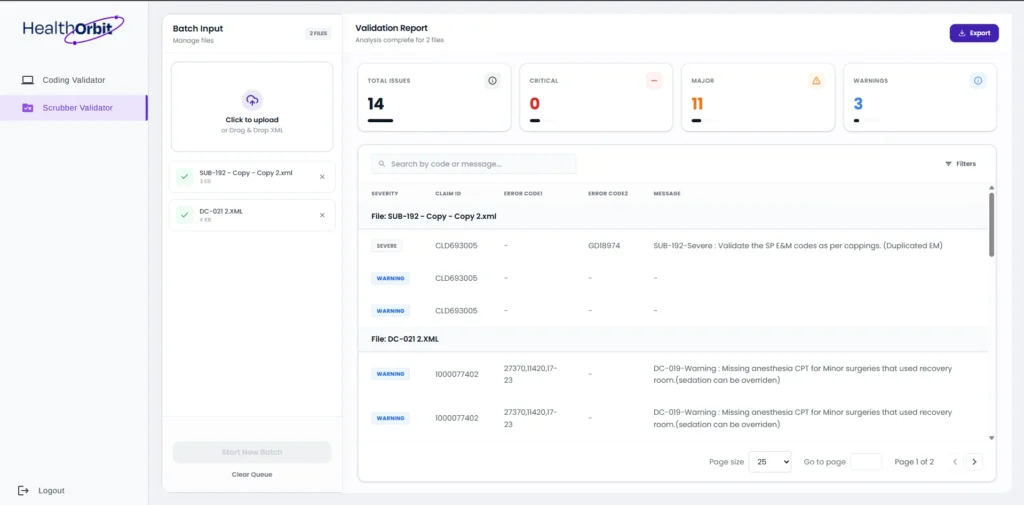
Most tools on this list check claims line by line. HealthOrbit Claim Scrubber takes a different approach, validating the entire claim file at once and catching frequency, bundling, and diagnosis-sequencing issues that only surface when the full submission is checked together, not just individual codes. It also isn’t a standalone scrubber bolted onto other software; it sits inside HealthOrbit’s broader AI platform alongside a coding engine, working across payer logic in the UAE, UK, and South Africa.
- Validates full claim files, not just individual line items
- Runs pre-submission XML validation before files reach the clearinghouse
- Checks bundling logic and primary diagnosis positioning across the whole claim
- Built around payer rules for the UAE, UK, and South Africa
- Works alongside HealthOrbit’s AI coding engine, so coding and claim validation pull from the same data
What It Does Differently
It screens batches and XML files before they leave the provider’s environment, applying the same rules payers use to adjudicate claims. This gives structural validation at the file level, before anything reaches the clearinghouse, rather than a fix applied after a rejection comes back.
Markets It Covers
HealthOrbit is built around payer logic for the UAE, UK, and South Africa, three markets with very different claims infrastructure, from TPA-driven cashless workflows in the UAE to CCSD-coded private insurer claims in the UK to medical aid switching in South Africa.
Part of a Broader Platform
Claim validation isn’t isolated from coding. HealthOrbit’s scrubber works alongside its AI coding engine, so both pull from the same clinical data instead of running as two disconnected systems that need separate corrections.
2. eClaimLink
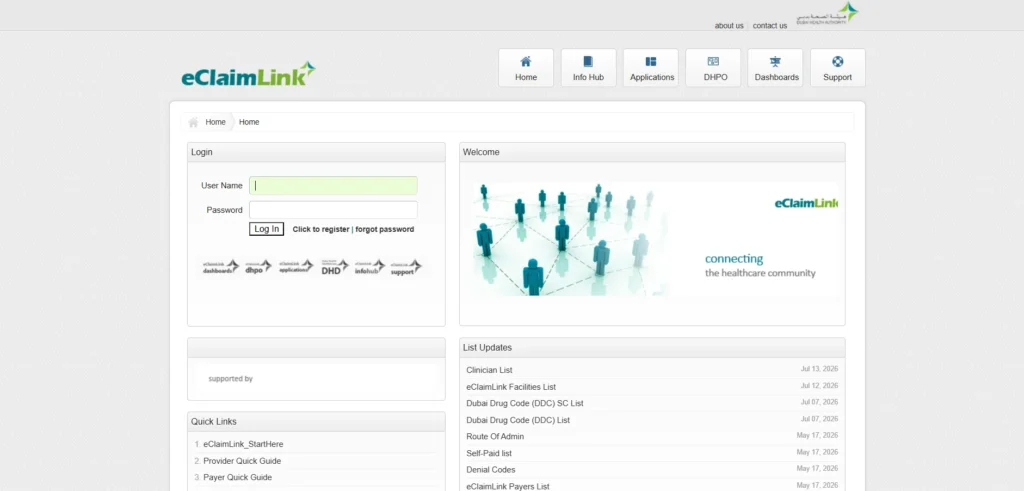
eClaimLink is the Dubai Health Authority’s official platform for claims validation and exchange across the UAE. Every claim moving between providers, insurers, and TPAs runs through it, so it’s less of a product choice and more of a required checkpoint for anyone billing in the emirate. It functions like claim validation software UAE providers can’t really opt out of.
3. MedicoPlus
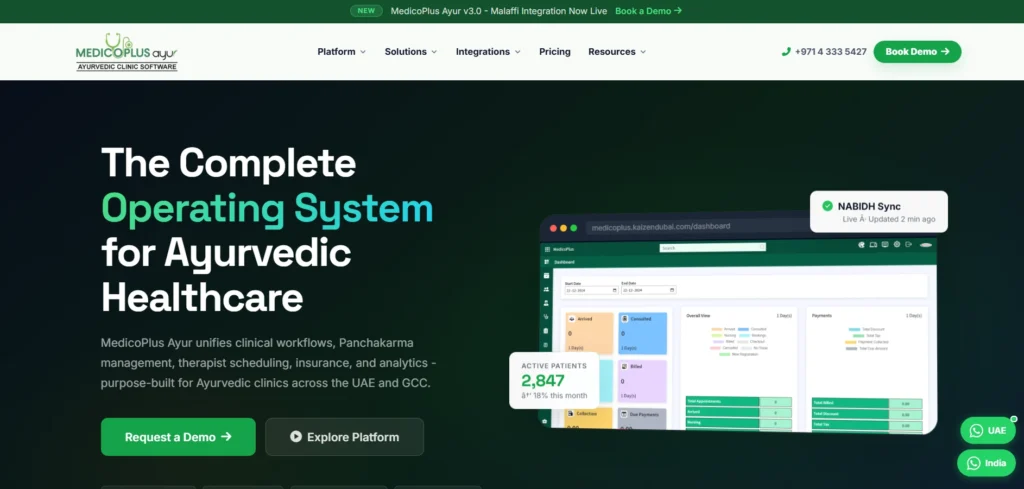
MedicoPlus covers the UAE billing cycle end-to-end, including eligibility checks, pre-authorisation, claim submission, and rejection tracking, built around TPAs like Daman, AXA, ADNIC, and NAS. The rejection tracking is what sets it apart. Most tools stop at flagging the error; MedicoPlus keeps following the claim after submission.
4. Aafiya
Aafiya is a UAE TPA with AI built into the approval process, aimed at speeding up cashless claims between providers, insurers, and members. For high-volume clinics, that turnaround time matters just as much as catching errors upfront.
5. Healthcode

Healthcode is the UK’s official clearing service for private medical insurance claims, used by every major insurer, including Bupa, AXA Health, and Aviva. It validates CCSD-coded invoices before they reach an insurer. Any claim scrubber software built for the UK private market ends up plugging into Healthcode one way or another.
6. FlowForma

FlowForma is a no-code automation platform that several NHS trusts use to digitise claims workflows that used to run on paper. It’s less about catching individual coding errors and more about removing the manual bottlenecks that cause claims to stall between departments.
7. Medesk
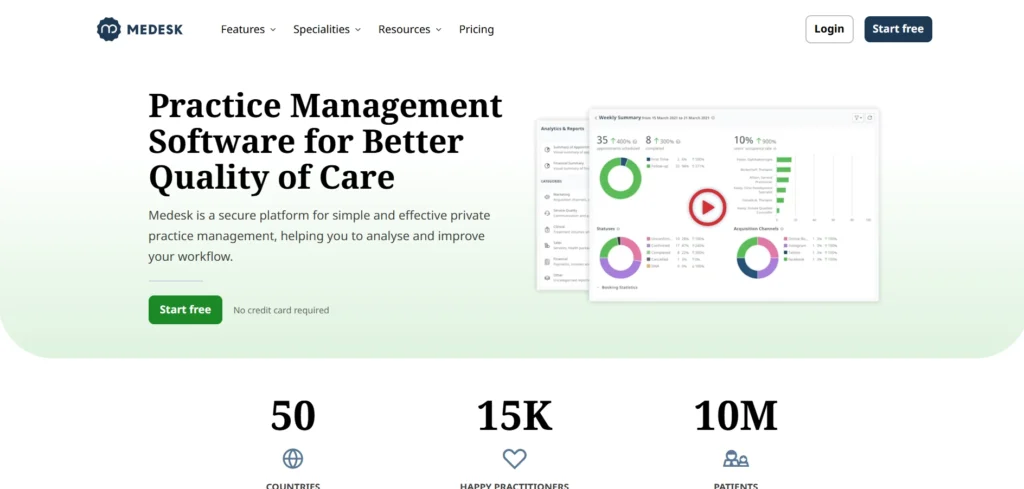
Medesk is UK practice management software with Healthcode built directly in, so claims move from a patient record to the insurer without manual CCSD code entry. It’s aimed at private clinics that want billing and clinical software in one place.
8. MediKredit (HealthNet ST)

MediKredit runs the HealthNet ST switch, connecting close to 9,000 South African providers to medical aid schemes for real-time claim validation. As claims rejection software goes, the real-time check matters; errors surface while there’s still time to fix them the same day.
9. MediSwitch
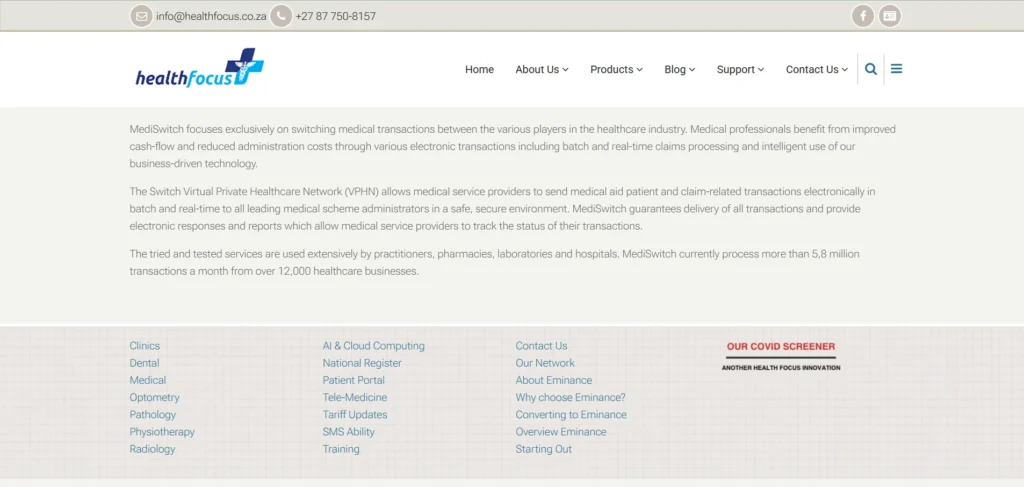
MediSwitch, under Altron HealthTech, is another major South African claims switch linking practice systems to scheme administrators. Its value is standardisation, translating claims into whatever format each scheme expects instead of practices adjusting manually per scheme.
10. GoodX

GoodX is a South African billing platform with real-time claim switching built around local tariff structures and POPIA compliance. It works more like a full practice management system that happens to validate claims, similar to how AdvancedMD works in other markets, just built for South African scheme rules.
Claim Scrubber in Healthcare vs Traditional Manual Review
Manual review still has a place, especially for complex cases that need a coder’s judgment. But it doesn’t scale. A biller checking claims by eye can catch an obvious typo, not a bundling conflict buried across dozens of line items or a payer rule that changed last month.
Medical claim scrubber tools run the same checks a payer will run before the claim ever leaves your building. They don’t replace coders; they clear the routine errors off their desks so people can spend time on claims that actually need judgment. Manual review, by contrast, tends to catch problems after the fact, once a denial has already cost time and money.
Key Features to Look for in a Medical Claim Scrubber
Ask ten billing managers what matters most, and you’ll get ten slightly different answers. But a handful of things make claim validation software actually worth paying for, no matter the practice size.
Must-Have Capabilities
- Real-time edits, so an error gets flagged while the claim is still on screen, not three days later in a rejection report
- Payer rules that stays current. CMS changes things quarterly, and commercial payers don’t wait for anyone
- Solid coding checks against NCCI edits, MUE limits, and modifier logic
- Reports a person can actually read, not a code dump that sends someone back to a manual
- It has to work with whatever system you’re already running. Nobody wants to rip out an EHR just to add a scrubber
Before signing anything, ask how often the rule library gets updated. A scrubber running old rules can be worse than no scrubber at all, because it feels like protection right up until a claim comes back denied.
Common Mistakes That Trigger Claim Rejections
Most rejections don’t come from anything complicated. They come from small things that slip through when someone’s moving fast.
- A modifier that doesn’t match the procedure code
- Patient demographics that don’t line up with what the payer has on file
- Diagnosis and procedure codes that don’t support each other
- Duplicate claims sent by accident, often after a system hiccup
- Missing prior authorization for a service that needed one
- Formatting that one payer wants and another doesn’t
None of these need expensive claims rejection software to catch. They just need a system paying attention every time, not just on a good day.
Conclusion
Picking claim scrubber software really comes down to your payer mix, your claim volume, and what you’re already running, not whichever vendor shouts the loudest. The ten tools above cover a lot of ground, from big enterprise platforms to options built for smaller teams.
Whichever one you pick, the payoff’s the same. Fewer rejections, faster payment, and staff who aren’t stuck reworking the same claim twice. Most denials could’ve been caught earlier. That’s the whole point of having a scrubber in the first place.
FAQs
What does a claim scrubber actually check for?
Coding accuracy, patient details, payer-specific formatting, bundling conflicts, duplicate submissions. Pretty much anything that could send a claim bouncing back.
Is claim scrubber software worth it for a small practice?
Honestly, yes, maybe even more so than for a big one. A single denial hurts a small practice’s revenue a lot more, and plenty of tools out there are built with smaller teams in mind.
What’s the difference between claim scrubbing and denial management?
Scrubbing happens before you submit. Denial management kicks in after something’s already been rejected. One’s about prevention, the other’s cleanup.
How often do claim scrubbers update their payer rules?
Depends on the vendor, so just ask. CMS updates its rules quarterly, and commercial payers change things even faster. Old rules sitting in a scrubber can hurt more than help.