
Are you observing the rapid transformation in clinics? The front-desk units used to make individual phone calls, dialling out to patients for appointment reminders. But it is changing with advanced technology. Today, many clinics use automated appointment reminders to confirm visits, cut no‑shows, and keep schedules full. It’s not about replacing staff. At HealthOrbit AI, we focus on supporting clinicians without adding more work to their day. But, still confused about choosing between automated calls vs manual calling? See how HealthOrbit AI helps.
What Are Automated Patient Appointment Reminders?
In simple terms, automated patient appointment reminders are pre‑scheduled calls, texts, or voice messages that run automatically before a visit. They allow patients to confirm, cancel, or reschedule appointments without staff involvement. A successful HIPAA-compliant tool will be connected with an EHR system for the scheduling details.
How does an appointment reminder system work?
Modern systems integrate with tools like an AI Voice Assistant, so reminders sound natural, not robotic. This matters more than clinics realize. For example, an appointment reminder system can help with:
- Pull appointment details directly from the schedule
- Send reminders based on preset timing
- Let patients confirm or cancel easily
- Update the clinic schedule automatically.
Why Appointment Reminders Matter in Healthcare?
The cost of missed appointments is higher than the cost of lost time to the clinics. They disrupt care, create scheduling gaps, and eat up revenue. Many reports in the health services literature document rates between about 10 % and 30 %, depending on the clinic type and setting. The patient behavior research shows that approximately one-fourth of the missed visits are due to simply forgetting.
The real cost of missed appointments
- Lost provider time
- Delayed patient care
- Overbooked rescheduling queues.
- Increased staff stress
Timing matters more than clinics think.
The research has revealed a better performance of reminders that were sent 3 days before the appointment as compared to those sent 1 day before the visit. The adoption of this method by clinics has resulted in improved attendance and lead time on cancellations. Patients have become demanding as they want to get in touch with someone immediately.
What Is Manual Calling in Clinics?
The traditional method is manual calling, in which an administrative person manually calls patients to verify their appointments. Such manual calling in clinics is typically made over the phone at working hours and depends on the availability of the staff, on the script of the calls, and manual tracking.
Common challenges clinics face
- Limited staff availability
- Inconsistent messaging
- No confirmation tracking
- Burnout during peak hours
Automated Calls vs Manual Calling — Key Differences
The issue of manual calling versus automation isn’t just an operational issue anymore. It has a direct impact on no-show rates, stress in the staff, and patient experience. As appointment volumes grow, clinics must decide whether traditional calls can keep up or if an appointment reminder system for clinics offers a better long-term solution. The given comparison will help you in making a decision:
Speed and scalability
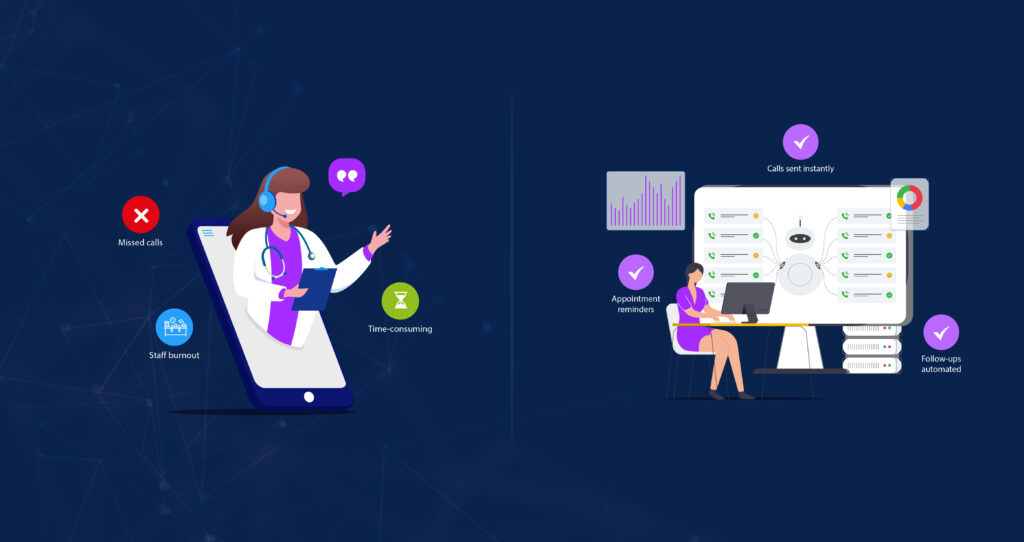
In Manual calling, the administrative staff can only make a limited number of appointment confirmation calls each day. Missed calls have to be called in again, further slowing outreach. Due to an increase in the number of patients, the manual work is unable to handle the volume of patients, particularly at the busiest periods in the clinic.
Automated appointment reminders scale instantly. A single appointment reminder system for clinics can reach hundreds of patients within minutes. Clinics are capable of transmitting alerts of same-day visits, modifications, or mass messages to the schedule without staffing or time requirements. It is a fast and convenient way to make reminders.
Consistency and accuracy
The delivery of the message is left in the hands of the individual making the manual call. Information could differ depending on recall, workload, or exhaustion. Also, there could be chances of human error. Critical details such as time or place of appointment or instructions to prepare can be overlooked or delivered sporadically.
The automated systems provide the same precise message each time. The dates, time, provider name, and instructions remain the same in any of the reminders. This consistency minimizes the chances of confusion and enhances patient confidence in communications at clinics.
Staff workload and operational efficiency
Employees waste hours making calls, leaving messages, and recording calls. This monotony of work takes the focus off other in-clinic requirements such as check-in, billing inquiries, and patient assistance. Hence, results in adding kerosene to the hectic workdays.
Follow-up of patients is automated and eliminates calls in the daily routine. Employees no longer seek confirmations and can get down to more important business. The work of clinics becomes smoother and less disrupted by the number of interruptions and the administrative workload.
Patient reach and response behavior
The clinic must be able to call patients at their convenience. The response rates are usually low due to unresponsive missed calls. It is particularly challenging to reach working patients or younger people.
Automated tools allow patients to respond at their convenience. They can confirm, cancel, or reschedule at any time, enhancing engagement and decreasing no-shows. Such flexibility is more in line with the modern preferences in patient communication.
Clinics using patient follow-up automation consistently report fewer last-minute gaps in schedules.
A Quick Comparison Table: Automated vs Manual Calling
The decision to use automated calls or call manually may always depend on the time and money. The two methodologies are both designed to reduce no-shows and enhance communication, although they do so in entirely different ways. Automated systems concentrate on size, regularity, and velocity, whereas manual calling is based on workforce and accessibility. The following table summarizes the main differences, allowing for a clear picture of what approach to choose, based on the workflow, number of patients, and growth strategies.
| Aspect | Automated Calling | Manual Calling |
| Cost | Lower long-term cost; fixed monthly or usage-based pricing | Higher ongoing costs due to staff time and labor |
| Features | Automated reminders, confirmations, rescheduling, multi-channel outreach | Appointment confirmation calls, basic reminders, and limited follow-ups |
| Speed & Scale | Reaches hundreds of patients in minutes | Limited by staff availability and call volume |
| Consistency | Same message delivered every time | Varies by staff member, time, and workload |
| Staff Effort | Minimal staff involvement once set up | High manual effort and daily repetition |
| Patient Response | Patients can respond anytime | Patients must be available during call hours |
| Pros | Saves time, reduces no-shows, scalable, reliable, and efficient | Personal touch, flexible conversations |
What Are the Benefits of Automated Clinic Systems?
It is not just that automated systems send reminders. They streamline the routine of the clinics, allowing them to focus on patient care and other necessary stuff. Clinics using automated appointment reminders report:
- Fewer no-shows, because patients can confirm or cancel in time.
- Faster schedule recovery when patients cancel early instead of at the last minute.
- Less pressure on front-desk staff and fewer clogged phone lines.
- Happier patients who appreciate clear, timely communication.
- Better use of available appointment slots instead of letting them go to waste.
This is where AI automation in Healthcare becomes a competitive advantage, not just a convenience.
How HealthOrbit AI Simplifies Automated Appointment Reminders for Clinics?
HealthOrbit AI is an automation tool based on a realistic clinic workflow, rather than abstract features. Its reminder applications are linked with scheduling and communication layers, and it uses voice-based outreach, which is human. Clinics can adjust timing, scripts, and follow-ups without incurring technical burdens. We make the interaction more natural than generic SMS alone.
HealthOrbit AI also supports AI-driven patient engagement, ensuring reminders fit naturally into broader communication flows instead of feeling isolated. The combination of reminders with smart voice delivery helps clinics to decrease friction and increase response rate.
Conclusion
Even manual calling has not been ousted. Nevertheless, it cannot support modern clinics alone. Automated appointment brings consistency and efficiency problems without sacrificing patient connection. If you use automation tools properly, they decrease no-shows, safeguard staff time, and enhance patient experience. Automation is no longer a choice and is something that clinics with limited resources have to consider in terms of growth.
Revolutionize the way of appointment reminders! Begin simplifying patient communication with HealthOrbit AI. Sign Up Now
FAQs
Do automated appointment reminders really reduce no-shows?
Yes, various medical research has demonstrated a decrease of between 30% and 60% in the case of reminders.
Are automated calls better than manual calls?
The automated calls are better suited to scale and lessen the workload of employees. Manual calls are only effective when there is low volume.
Do patients respond to automated reminders?
Yes, patients would also like to receive reminders that they can verify themselves at their convenience.
Can automated systems replace front-desk staff?
No, they eliminate redundant duties to allow the personnel to concentrate on the patients.
Is automation suitable for small clinics?
Yes, clinics that have fewer staff members tend to gain the most by having less staff pressure and an improved ability to schedule.