Clinical research is demanding. Whether you’re running large-scale trials or gathering observational data in a clinic, documentation is critical, but also one of the biggest bottlenecks. Every form, progress note, and update takes time. And in research, precision matters.
That’s where AI in clinical research is making a quiet revolution.
From patient screening to site monitoring, ambient scribe systems like those from HealthOrbit AI help research teams work smarter, not harder. With clinical notes AI and real-time transcription built around your study protocol, researchers are spending less time typing and more time discovering.
The Role of AI in Clinical Research
Artificial intelligence and clinical trials are improving the clinical research industry by making studies complete faster, more efficiently, and helping to achieve better results. Analysis of a lot of data at any point during the study and better recruitment of patients are ways AI supports accuracy in every trial. This is the main reason that more investigators are adopting AI in clinical trials research tools.
Accelerated Patient Recruitment
Finding and recruiting patients is one of the main problems in clinical research. With the help of AI, this task is simplified and sped up by evaluating huge amounts of records and patient profiles to identify suitable patients. It makes the process more automated, so it finds better matches based on complicated criteria. As a result, trials for hard-to-find diseases or those that use particular biomarkers enroll their participants more swiftly, helping the study be launched on schedule.
Smarter Trial Design
Currently, AI tools review trial history, scientific progress, and real facts to make designing better trials viable from the beginning. AI assesses various trial designs and proposes the best set of parameter values, for example, the most appropriate primary outcome, the way the control group will be managed, and the right medicinal schedule. Consequently, studies are more adaptable, safer from failure in the middle, and work more efficiently.
Real-Time Data Monitoring
Most of the time, traditional monitoring only occurs after some time has passed and requires urgent action. Real-time surveillance is supported by AI because it can instantly detect any unusual data, flags, or trends during the trial. As soon as the issue is spotted, research teams can protect patients and maintain important and ethical trial data.
Enhanced Predictive Analytics
By using AI, predictive analytics in clinical research foresees results using a mix of previous data, input data, and advanced algorithms. The model helps companies see if the website might not function correctly, if study participants are likely to leave the study early, or if risks are expected, so actions can be taken ahead of time. This makes it easier to manage resources, choose the best recruitment methods, and decide, thanks to data, whether to continue or halt the trial and increase the chances of the trial being successful.
NLP Technology for Unstructured Data
Much of the clinical data is available as free text in statements from physicians, diagnoses from pathology, summaries of a patient’s discharge, and comments on lab work. Using NLP, researchers can find important and organized information in the unstructured texts of medical notes. As a result, the data becomes valuable and shows more details about the patient’s treatment and what was studied in the research.
Better Regulation Compliance
Like all aspects of drug discovery, clinical trials are controlled by strict laws, and a small inconsistency may result in slower approvals or problems with the correctness of data. AI makes sure that all the necessary documents are accurate, consistent, and ready if audited at all times. Using AI, researchers are able to manage unusual protocol behaviors, know what is missing for their upcoming audits, and ensure their data is complete.
AI-Powered Virtual Trials
AI is helping DCTs by making research more focused on the needs of patients. With the help of AI, clinical trials can now be partly or fully performed in different locations rather than just in hospitals. It automatically checks if the patients follow the protocol, looks for side effects, and records outcomes reported by patients, which takes little effort from both parties.
Smarter Clinical Trial AI = Better Protocol Adherence
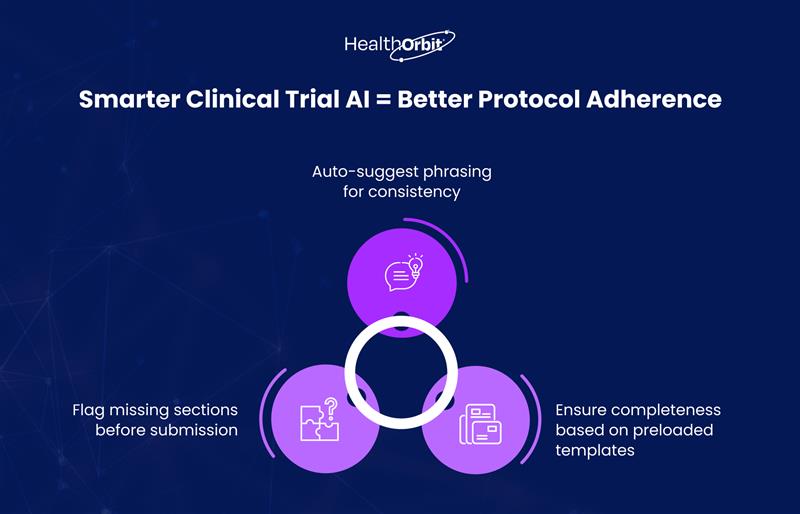
Protocol deviations cost time, money, and credibility. With clinical trial AI tools listening and learning during patient interactions, your system can gently prompt clinicians to capture required endpoints, assess eligibility, or log AEs immediately. That supports protocol adherence without interrupting the patient visit.
For example, if your protocol requires specific wording or check-ins, the system can:
- Auto-suggest phrasing for consistency
- Flag missing sections before submission
- Ensure completeness based on preloaded templates
This subtle support leads to tighter data capture and fewer monitoring queries.
The Power of Real-Time AI Clinical Intelligence
In traditional trials, insights come weeks or months later. But real-time AI Clinical Intelligence tools offer instant summaries and trend analysis, helping investigators:
- Spot early safety signals
- Track patient progress accurately
- Identify outliers before they skew results
Combined with ambient technology, the data appears passively while conversations happen naturally.
For studies involving dermatology, oncology, or neurology, where descriptive notes matter, these tools make a major impact. The system listens quietly and structures notes without needing voice commands or dictation.
Improving Accuracy in Trial Documentation
If your team struggles with note completion or inconsistent visit summaries, you’re not alone. Documentation is often where trials slow down. With tools like HealthOrbit AI:
- Notes are generated during the visit, not after
- Context is preserved accurately
- Compliance checks are built in
Accuracy isn’t just about spelling or format—it’s about documenting the truth of the clinical interaction in a way that aligns with the protocol.
Streamlining Follow-Up Tracking in Studies
Follow-ups are essential in clinical trials, but are often delayed or missed due to human error or busy workflows. When an AI scribe tool is integrated with your visit scheduler and EHR system, it can automatically flag due dates, upcoming assessments, and required follow-up actions. This ensures continuity across visits and helps maintain protocol adherence.
The AI can also automatically insert protocol-specific check-ins directly into clinical notes, reducing the risk of oversight. By automating these critical tasks, research teams can significantly reduce participant drop-off rates and ensure that each patient’s journey through the trial is thoroughly and accurately documented.
Why HealthOrbit AI for Research Teams?
HealthOrbit AI goes beyond automation. It brings purpose-built tools for research professionals:
- Ambient technology that works in the background without disrupting visits
- Support for specialty-specific trials (oncology, dermatology, neurology)
- Seamless EHR integration and structured note capture
- Adherence to HIPAA compliance and regulatory requirements
You stay focused on the science while your notes write themselves.
Conclusion
When you combine intelligent systems with human care, research improves. Less burnout for site staff. Faster site activation. Cleaner monitoring reports. All while supporting real people in real time. AI in clinical research is not about replacing researchers—it’s about empowering them to do what they do best.
Ready to streamline your clinical research workflow with AI? Join HealthOrbit AI today
FAQs
Is AI documentation accepted in regulatory trials?
Yes. As long as it meets GCP and HIPAA standards and is reviewable and verifiable by clinicians, it can be fully compliant.
How does ambient scribe technology work in research visits?
It listens in the background and structures notes based on clinical context. You don’t need to issue voice commands or change how you speak.
Does HealthOrbit AI integrate with my EHR or CTMS?
Yes. HealthOrbit supports custom integrations with leading EHR and trial management systems to keep everything aligned.
What specialties benefit most from this?
Research sites in oncology, dermatology, neurology, and internal medicine often see the biggest gains, due to the complexity of their documentation.
How long does it take to onboard my research team?
Setup is quick, with minimal disruption. Most teams are up and running in just a few days.